Hospital Flower Vending Machines: Fresh Flowers Around the Clock for Patients, Families and Visitors
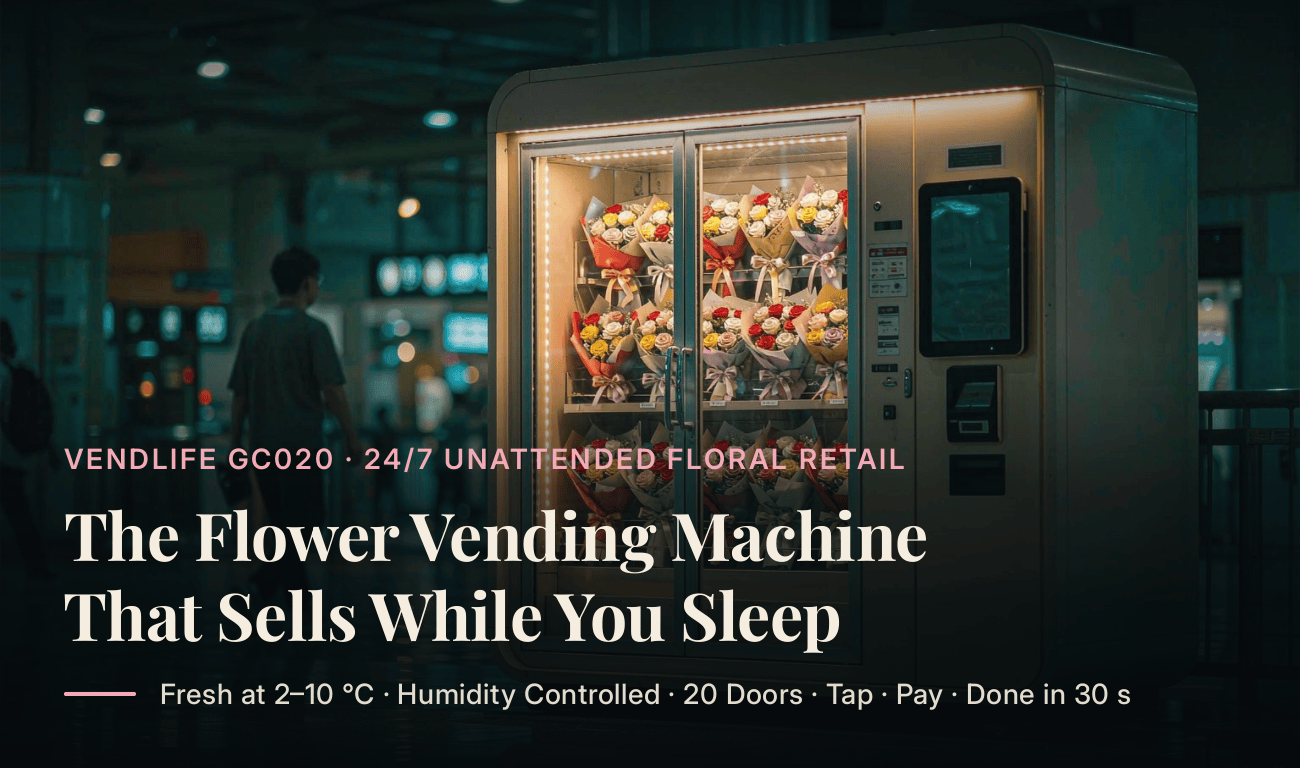
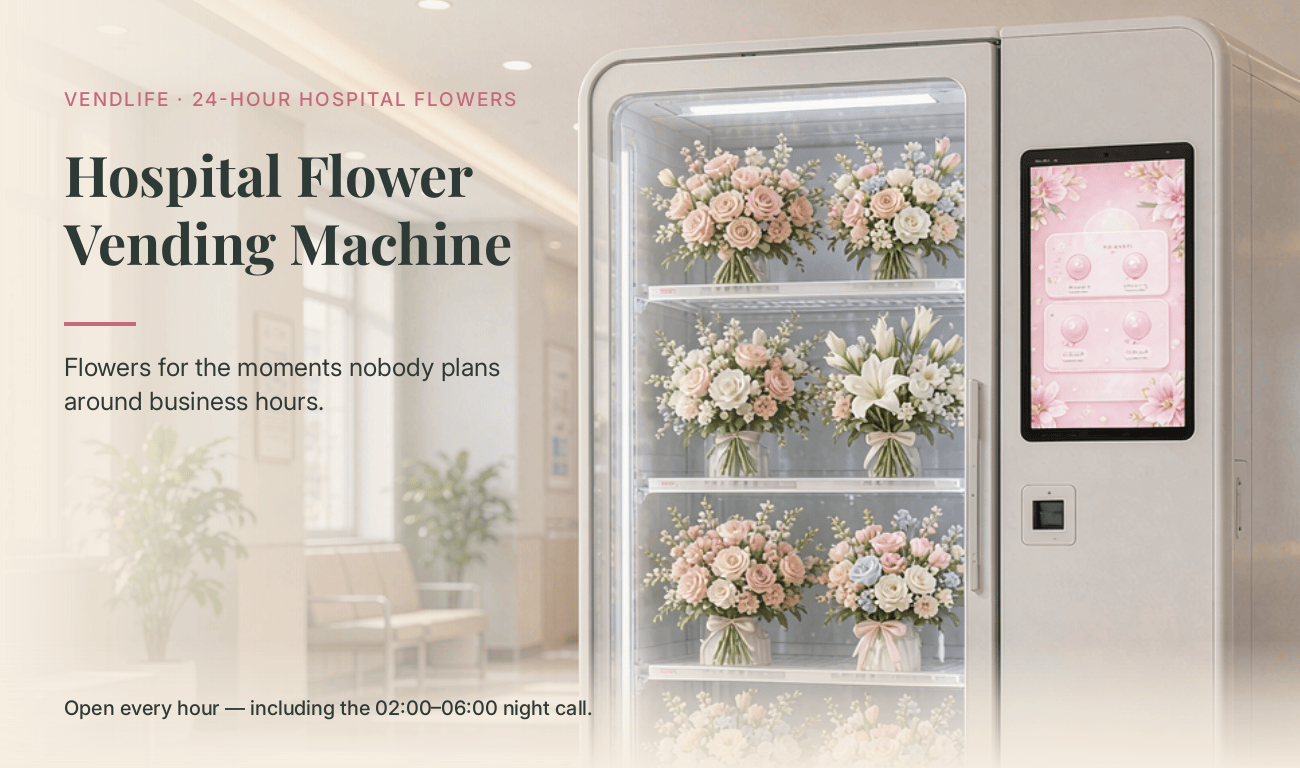
Quick answer: A hospital flower vending machine is a refrigerated Vendlife GC018 cabinet — quiet compressor, wipe-clean compartments, gentle presentation lighting and touch-free payment — installed in the main entrance vestibule or the outpatient hall. Stocked with get-well mixed bouquets, white sympathy arrangements, bedside mini-vases and pastel new-baby bunches, it covers the 02:00 bad-news call and the 07:30 pre-shift visit: two moments when every nearby flower shop is shut and a family still needs flowers. Because demand here is steady rather than spiky, most operators recover the outlay in 8–16 months.
Why Hospitals Suit Flower Vending Better Than Almost Any Other Venue
Mall and cinema flower sales are driven by impulse. A hospital flower vending machine sells on something stronger — obligation. A grandmother’s hip operation, a colleague’s diagnosis, a friend’s newborn, a father’s funeral. None of these are scheduled around a florist’s trading hours, and every visitor knows they should arrive with something.
- Demand that barely dips. Wards run 24/7 and admissions follow weekly rather than seasonal cycles, so mature sites typically move less than ±15 % month to month.
- Almost no substitute at the moment of need. A family reaching the hospital at 03:40 after a bad-news call usually has no florist open within 5 km. Price resistance effectively vanishes.
- The same visitor returns repeatedly. Relatives come to a bedside 5–15 times across a single stay, and every visit is another purchase opportunity.
- Self-service is the right fit emotionally. These buyers are not browsing. They want the right flowers immediately, without a conversation, and without being asked to describe a bouquet while they are close to tears.
This is rarely the highest-margin setting in the flower vending category, but it is often the steadiest — and for hospital management it is a real improvement to the patient-and-family experience, which is why tender panels increasingly look on it favourably.
Three Flower Ranges That Sell Around the Clock
Reliable 24 hour flower vending in a hospital depends on carrying three ranges at once. Door allocation is set during configuration, so the mix can be retuned after a month of sales data:
Get-Well Bouquets — the everyday volume driver
Bright, low-scent mixed bouquets that read as cheerful on a ward without overwhelming it.
What to stock in the get-well block
- Cheerful gerbera, chrysanthemum and rose mixes, chosen for low pollen and low scent.
- Compact 3–5 stem bunches sized for a bedside table rather than a reception desk.
- Every bouquet wrapped with a sealed water tube or water-absorbent pad — no loose water.
- A card slot at the compartment for “get well” and “thinking of you” messages.
Ward-safe rules for get-well flowers
- Avoid heavily scented lilies, hyacinths and gardenias — many wards restrict them.
- Trim or replace high-pollen blooms; loose pollen is a problem in respiratory areas.
- No tall or top-heavy arrangements; vases must sit stable on a bedside table.
- Boxed arrangements are safer than open vases wherever policy is unclear.
Sympathy and Bereavement — the highest-value block
White chrysanthemum, white lily and white rose arrangements, available at any hour of the night.
Why sympathy purchases cluster before dawn
- Bereavement notifications overwhelmingly arrive in the small hours.
- Operators consistently report 20–30 % of sympathy-block sales between 22:00 and 06:00.
- At that hour the machine is frequently the only flowers near the hospital still open.
- Price sensitivity is close to zero — buyers want something appropriate, immediately.
Handling larger funeral pieces
- Full funeral sprays are usually too large for standard compartments.
- Many operators position the machine as the “first flowers” — the immediate response.
- A QR code on screen links to a partner florist for next-day larger arrangements.
- This turns a size limitation into a referral channel instead of a lost sale.
New-Baby and Celebration — the maternity-floor peak
Pastel pink and blue bunches for the maternity corridor and everyone visiting it.
What sells on the maternity corridor
- Pastel pink and blue bunches, plus mixed gentle-toned arrangements.
- Light fragrance only — strong scent is unwelcome on a postnatal ward.
- Compact sizing that fits a bedside table alongside flowers already received.
- Strong gifting intent: visitors arrive knowing they will buy, not deciding whether to.
Small add-ons that lift basket size
- Single sunflowers and gerberas at US$6–12 for staff-to-patient gifts.
- Pre-printed “congratulations” and “welcome” cards from an add-on dispenser.
- High attach rate on cards — among the cheapest margin additions available.
- Low ticket, high frequency, and it keeps the cabinet relevant outside peak hours.
Side-by-Side: Which Range Earns Its Door Count?
A fourth block — single stems and mini vases at US$6–15 — usually takes the remaining doors. It contributes less revenue per sale but keeps the cabinet useful to staff and to visitors on a budget, and it fills the quiet hours between the three main peaks.
Where Hospitals Actually Place the Cabinet
Placement decides most of the outcome for a hospital flower vending machine. These positions consistently work, and the final card is the one to refuse:
Machine Configuration — Hygiene-First Spec
The GC018 hygiene variant behind every Vendlife hospital flower vending machine is specified for corridors, waiting areas and vestibules rather than for a shop floor. Every choice below exists because a hospital asked for it:
- Model: Vendlife GC018, hygiene variant.
- Compartment layout: 5 levels × 4 lanes = 20 doors.
- Temperature: 5–12 °C — keeps arrangements fresh and stays inside hospital HVAC norms.
- Compressor noise: under 45 dB, which is mandatory anywhere near patient wards.
- Interior surface: wipe-clean stainless-steel compartment liner, with an antibacterial coating option.
- Touchscreen: 21.5-inch, with optional antibacterial film and an in-frame hand sanitiser dispenser.
- Payment: contactless card plus QR to minimise touch; coin acceptor optional.
- Interface: Chinese and English minimum, with a sympathy-mode toggle that dims the screen after 22:00.
- Lighting: warm 3000 K LEDs — welcoming rather than clinical.
- Doors: soft-close hinges, so nothing slams in a quiet corridor.
- Dimensions: H 1840 × W 1600 × D 660 mm.
- Power: 220 V / 450 W.
- Certifications: CE, CQC, FCC, ISO9001, KC.
Hospital-specific options worth adding: an integrated hand sanitiser dispenser; the sympathy-mode interface, which dims after 22:00 and brings the white block forward; a staff-badge discount of 10–15 %; and a funeral-director referral card for discounted sympathy pieces.
Ward Rules and Items to Keep Out
- ICU, burns and respiratory wards frequently prohibit fresh flowers altogether — and in some cases artificial ones as well.
- Lilies are banned in many European hospitals because of pollen toxicity risk.
- Vases holding standing water are prohibited across many wards: bacterial growth plus a spill hazard.
- Silk and artificial flowers are sometimes excluded for infection-control reasons too.
- Greeting cards may need to be pre-printed rather than handwritten at the cabinet.
- Confirm the final SKU list with facility management before installation.
- Boxed arrangements are safer than vase arrangements.
- Pre-wrapped bouquets are safer than loose flowers.
- Vendlife’s hospital-mode layout is built to satisfy typical ward restrictions.
How Hospital Tenders and Deals Are Structured
- Public hospital concession: a fixed annual licence fee plus 5–15 % revenue share on top, usually multi-year (2–5 years) and renewed by tender.
- Private hospital direct deal: a simple revenue share of 15–30 % with no base fee — quicker to close and more flexible.
- Hospitality or catering partner: sub-contracted through the existing retail concessionaire; common across large private groups.
- Charity-linked arrangement: the cabinet is operated by a hospital foundation and revenue funds patient support — increasingly common in the UK, EU and Japan.
Winning tenders here is less about commercial terms than about reassurance. Lead with your sanitation protocol, because hospital procurement weighs patient experience, hygiene and reliability above revenue share. Offer a 30-day free trial. Show you understand ward restrictions — a proposal that states which flowers are banned where is immediately more credible. And consider a charity-linked model donating 5 % of revenue to the hospital foundation, since public tender scoring often rewards that explicitly.
ROI Math
Hospital flower vending machines are among the most predictable performers in the category: sales hold steady, seasonality is mild, and once a cabinet is in the vestibule it usually keeps that position for years. The base case assumes a general hospital with 500+ beds; below 200 beds, plan on the conservative case or lower.
Frequently Asked Questions
Do hospitals actually permit a hospital flower vending machine on site?
- Yes, increasingly. Facility managers recognise that flowers are part of the patient-and-family experience, and a 24/7 cabinet meets a need no on-site retail florist can cover. Public tender rules still vary by jurisdiction.
Which flowers are acceptable in hospital wards?
- Rules differ, but the common pattern is: no heavily scented lilies or hyacinths, no high-pollen arrangements, no loose water, and no vase arrangements in ICU, burns or respiratory wards. Confirm with facility management before locking the SKU list.
Do people genuinely buy sympathy flowers at 3 a.m.?
- They do, and it is one of the most consistent behaviours in the entire flower vending category. Bereavement notifications tend to arrive pre-dawn, and the machine is then the only flowers within reach. Many operators see 20–30 % of sympathy-block sales fall between 22:00 and 06:00.
Can the cabinet also dispense cards?
- Yes. Pre-printed “get well”, “thinking of you” and “with sympathy” cards fit a small add-on dispenser beside the touchscreen, and the attach rate is very high.
What about full funeral arrangements?
- Those are generally too large for standard compartments. Most operators treat the machine as the immediate “first flowers” response and put a QR code on screen linking to a partner florist for next-day larger pieces.
Are extra medical or safety certifications required?
- Usually not beyond standard vending certifications. What matters is demonstrating hygiene discipline — antibacterial surfaces, sanitiser provision, sealed water packets — because that is what procurement reviewers focus on.
How does infection control affect where a hospital flower vending machine sits?
- Place it so it never blocks hand-wash stations, never sits inside a clinical zone, and can be wiped down under facility protocol. The hygiene-variant interior liner is designed to make daily wipe-down quick.
How many hospital flower vending machines does one hospital support?
- Typically one, in the main vestibule. Larger sites with separate outpatient, maternity and ICU buildings may support two to four — one per building entrance.
Is demand for a hospital flower vending machine seasonal?
- Only mildly. Winter flu and respiratory months lift admissions and therefore get-well sales; summer road trauma lifts the sympathy block. Overall it is the least seasonal of the main flower vending scenes.
What causes the most operational friction?
- Restocking at awkward hours, since some facilities restrict it to early mornings; keeping up with ward-rule changes; and flu-season demand swings. All manageable, but build them into the operating schedule from day one.
Vendlife supplies hospital flower vending machines with hygiene-first configuration, ward-safe SKU guidance and the documentation hospital tenders ask for — public liability, insurance and restocking protocols. Send us your hospital profile, bed count and ward policies and we will return a spec, a placement plan and a configuration quote within one business day.
Email vendlife@126.com · WhatsApp +86 13076886084
Vendlife · 3rd Floor, Building 7, Shunde Central Zhicheng, No. 3 Industrial Road, Xianyong Village, Chencun Town, Shunde District, Foshan City, Guangdong, China. Specifications refer to the GC018 hygiene variant; final configuration is confirmed against your ward policies and local regulations.