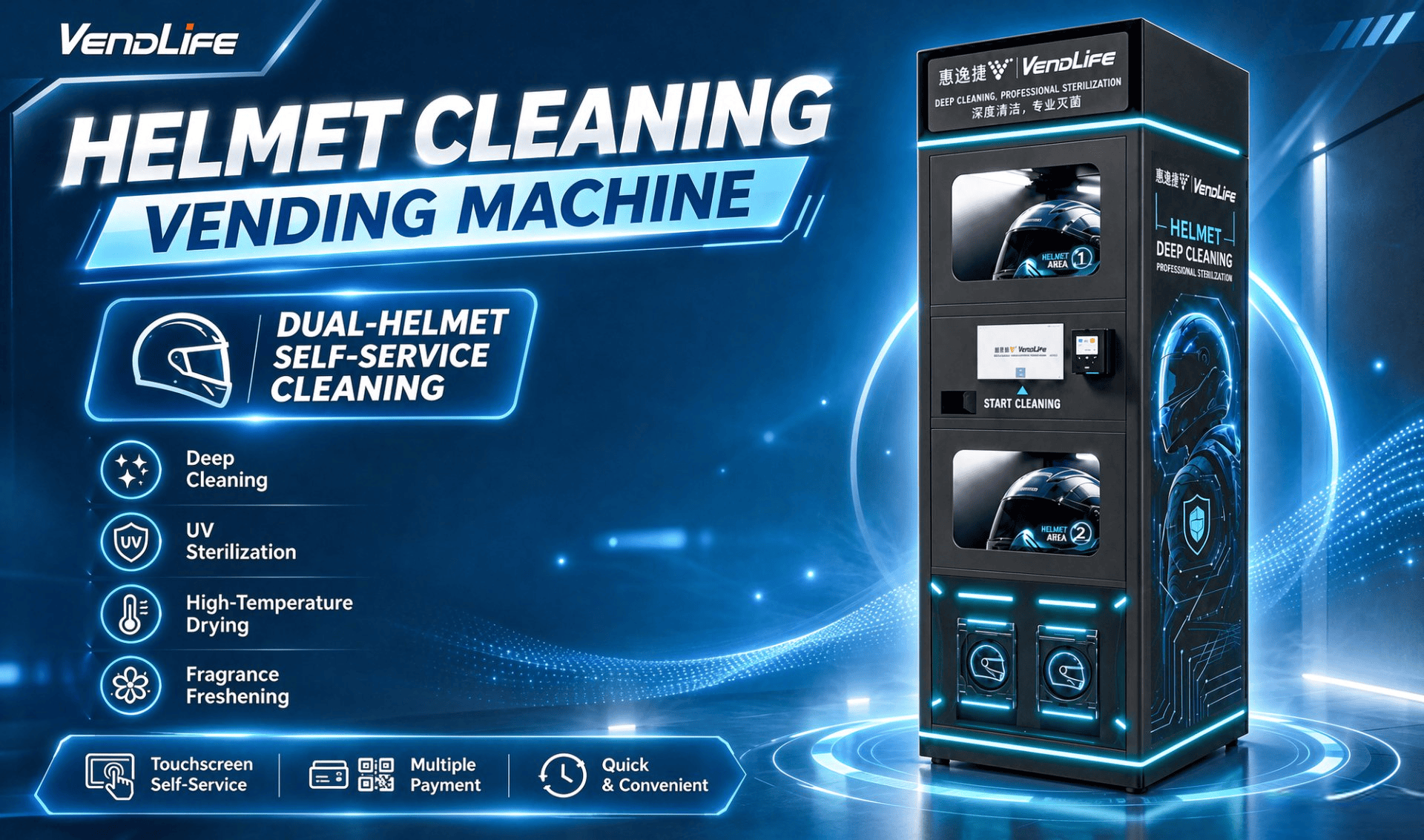
A rental helmet can change hands a dozen times before sunset, and every handover carries the same unspoken question from the rider: has this been cleaned? For most operators the honest answer has been a spray bottle, a rag and whoever happens to be free — a routine that is slow, inconsistent and impossible to prove. Automated helmet care stations replace that routine with a metered, unattended process that customers run themselves and pay for by the cycle.
This analysis covers where the model came from, what the hardware actually does inside a single cycle, how operators should read the numbers behind it, and what distributors need to specify before committing to a container.
The Shift From Staff-Washed Gear to Pay-Per-Use Hygiene
Helmet cleaning used to sit firmly on the cost side of a rental business: an hour of staff time, a drying rack in the back room, and no way to charge for any of it. Three pressures have moved it to the revenue side.
- Fleet density. Rental depots, riding schools and tour operators now hold hundreds of helmets rather than dozens, and every unit has to be serviceable before the next handover.
- Provable hygiene. Insurers, venue landlords and corporate clients increasingly ask operators to document cleaning routines instead of describing them.
- Customer expectation. Riders who accept a second-hand helmet still expect it to smell neutral and feel dry — a low bar that manual washing misses routinely at peak hours.
A metered station turns all three into a transaction. The rider pays a small fee, the cabinet runs a fixed programme, and the operator ends up with a timestamped record rather than a verbal assurance.
What Happens Inside the Cabinet, Minute by Minute
Cycle timing shifts with the programme selected, but the sequence inside a commercial unit follows a predictable arc. The timings below describe a standard cleaning programme.
Minute 0 — Intake and Load
The rider places the helmet in an open compartment and confirms the programme on the 10.1-inch touchscreen. Two independent bays let the cabinet serve two customers at once, so a queue of two does not become a queue of twenty. Payment clears through the integrated POS terminal or a QR scan before the electronic lock engages.
Minutes 1 to 7 — Wet Wash
A programmed wash stage lifts dust, sweat salts and road film from both the shell and the interior lining. Because the enclosure contains the water, the floor stays dry — the detail that decides whether a dealership can put the unit on the sales floor or has to hide it in a back room.
Minutes 8 to 14 — Ultraviolet Dwell
After washing, an ultraviolet stage holds the helmet for a disinfection dwell. This is the part customers actually care about: odour and skin irritation come from microbial growth in damp padding, and UV treatment addresses it without soaking the lining again.
Minutes 15 to 21 — Thermal Dry
Warm forced air drives moisture out of the padding, straps and buckle assembly. Dryness is the operational bottleneck in any fleet — a helmet that leaves the cabinet damp cannot be reissued, so drying speed sets how many units a single cabinet can realistically support.
Minute 22 — Finish and Return
A fragrance stage closes the programme, the smart lock releases and the door opens for collection. From the rider’s side the whole interaction is one screen, one payment and one wait — no attendant, no cash, no explanation needed.
The Operator’s Ledger
Payback in this category is driven less by the price of the cabinet than by utilisation — how many paid cycles a location can genuinely generate in a week.
Where Revenue Accumulates
Three streams usually appear once a station is running: walk-up per-cycle fees from individual riders, contract allocations where a fleet operator buys blocks of cycles for its own customers, and attachment revenue where the cabinet sits inside a shop that also sells helmets, gloves or accessories. The third is often the largest and the easiest to overlook.
Where Costs Sit
Power draw dominates running cost — the unit is rated at 6,500 W, and the heating and drying stages account for most of it, so a site with a favourable daytime tariff and steady footfall outperforms a discounted location with intermittent use. Consumables stay modest: water treatment, fragrance cartridges and filter service. Labour is limited to loading, emptying and periodic wipe-down, which is why one attendant can supervise several cabinets.
The Payback Question
A usable model needs four inputs and nothing more: the per-cycle fee the local market will bear, a realistic daily cycle count, the installed cost including freight and commissioning, and monthly service overhead. Operators who model on peak-season footfall alone tend to over-order; those who model on the quietest month size correctly, then add a second cabinet when the first saturates.
Matching the Cabinet to Your Footprint
The same hardware behaves differently across venue types, because the binding constraint changes — queue tolerance in one location, ceiling height in another, payment habit in a third.
Captive Fleets — Rental Depots, Riding Schools, Tour Operators
Here the station works as back-of-house equipment with a customer-facing payment screen. Throughput matters more than ambience: two treatment bays, a storage cabinet below for overflow helmets, and cloud monitoring so a depot manager can see which units were serviced and when.
Walk-In Commuters — Metro Concourses, Malls, Campus Gates
These sites live on impulse and dwell time. The unit has to be visible, self-explanatory and quick, with cashless payment as the default rather than an option. Signage does most of the selling; the screen only has to confirm a decision the rider has already made.
Destination Retail — Dealerships, Gear Shops, Service Bays
A dealership can attach the cabinet to a purchase promise: clean the helmet you just bought, or the one you brought in for a service. Standing on the showroom floor, it also signals that the business takes gear care seriously — worth more than the cycle revenue in most cases.
One practical caution. The cabinet draws 6,500 W at peak and must sit on a dedicated circuit sized for that load. Sites that share a circuit with workshop equipment tend to trip breakers during the drying stage, which is the fastest way to lose customer confidence in the first week.
Procurement Notes for Distributors and Private-Label Buyers
Buyers importing for resale or building a local brand face a different set of decisions from the operator installing a single unit.
Specify the Interface, Not Just the Cycle
Display size, language set, payment module and network path — 4G, Wi-Fi or wired Ethernet — determine whether a unit can be deployed in a market without modification. A machine locked to one local payment terminal becomes unsellable one border away.
Verify the Service Model
Cloud management, real-time status and remote fault diagnosis are what make a distributed fleet supportable. Ask how firmware reaches a unit in the field and who owns the monitoring account before signing; the answer decides whether after-sales is a phone call or a site visit.
Negotiate the Long Tail
Cabinet colour and branding are customisable, and OEM/ODM programmes let a distributor ship a house-brand unit. The items worth writing into the contract are the ones that only matter later: spare-part lead time, documentation language, and remote technical training for the local service team.
Equipment Snapshot
| Footprint | 1,900 mm high × 600 mm wide × 590 mm deep, including the illuminated header |
| Installed weight | 130 kg |
| Rated load | 6,500 W at 110–240 V, 50/60 Hz |
| Operator interface | 10.1-inch touch display with multi-language programme selection |
| Payment | Integrated POS card terminal and QR code reader |
| Connectivity | 4G, Wi-Fi and wired Ethernet |
| Compartments | Two independent helmet bays plus a dual-helmet storage cabinet below |
| Internal storage | Two adjustable shelves as standard |
| Collection | Open-door pickup secured by an electronic lock |
| Treatment stages | Wash, ultraviolet disinfection, thermal drying, fragrance finish |
| Finish | Black as standard, alternative colours on request |
| Intended use | Motorcycle helmets and comparable protective headgear |
Model It Against Your Own Numbers
Hygiene is no longer something riders take on trust. A metered care station makes it visible, chargeable and repeatable — and for an operator running dozens or hundreds of helmets, that is the difference between an expense and an asset.
Share your venue type, expected daily volume and target market, and the team can return a configuration, a freight estimate and a deployment plan for a first site.
automated helmet care station, self-service helmet care kiosk, helmet washing and disinfection equipment, pay-per-use helmet hygiene station, helmet care for motorcycle rental fleets, ultraviolet helmet disinfection cabinet, helmet drying and fragrance machine supplier