Concert & touring popcorn · Operator playbook
Popcorn Vending Machines for Concerts: An Operator & Wholesale Guide
A concert crowd is the densest, most time-compressed snack opportunity a machine will ever meet. Pollstar’s 2025 year-end analysis put the average show at a record 19,104 tickets, and atVenu measured concert onsite spending at $10.24 per head. For an operator, one unattended popcorn vending machine monetises a two-hour window no staffed stall can cover. For a wholesaler, it is a repeatable B2B category — arenas, amphitheatres, festival circuits and tour caterers re-order on the same seasonal calendar.
Arenas◆Amphitheatres◆Festival fields◆Stadium tours◆Fan zones◆Touring fleets◆Wholesale & OEM◆24-hour unattended◆
Why concert nights out-earn every other popcorn placement
Cinemas and malls spread their footfall across a whole day. A show compresses it. Two hours after doors open, a venue can push a whole evening’s snack demand past a single point — and then the crowd leaves, whether or not anyone served it.
Three structural advantages separate concerts from every other popcorn location:
Density
Pollstar’s 2025 year-end analysis (published 12 December 2025) recorded an all-time high of 19,104 tickets per show across the Top 100 worldwide tours, with stadium shows averaging 56,272 attendees. Very few retail environments concentrate that many impulse buyers into one concourse.
Dwell time
Support act to headline to encore is 120–180 minutes of waiting, standing and queuing — the exact behaviour that turns a snack machine into an impulse channel. atVenu’s 2025 live-event data put concert food-and-beverage spend at $10.24 per head, up about 3% year over year.
Zero staffing ceiling
Interval and encore peaks last 20–30 minutes. A staffed stall cannot be scaled to that spike without overstaffing the other three hours; an unattended popcorn machine simply keeps popping.
The three revenue windows of a show night
Queue time
Bars back up as fans arrive and carry cups to the floor. Sealed-cup popcorn travels better than a bag of kernels.
The peak
Throughput, not price, is the limiting factor — a queue not served inside 60 seconds converts at a fraction of the rate.
Second wave
Fans leaving early to beat the traffic; exit-side machines capture spend the bars physically cannot reach.
Three numbers decide your specification
Before any specification discussion, measure these on your own site: doors-to-encore minutes, peak 30-minute footfall past your intended location, and current per-head snack spend. Those three figures decide whether you need one cabinet or two linked units — everything else is detail.
What operators must specify before ordering
A generic snack machine and a concert-grade popcorn machine differ in seven specification lines. Operators who skip them end up with a unit that jams at the interval.
Peak throughput
Interval bursts, not daily totals, decide revenue
Specify thisCups per hour at continuous operation, and how a second cabinet doubles it
Payment stack
Cash-heavy venues lose the under-30 crowd
Specify thisMDB/DEX support for contactless card, NFC wallet and QR — plus closed-loop ticket or wristband payment where the venue runs one
Connectivity
Restocking is planned from data, not by walking the concourse
Specify this4G / Wi-Fi / Ethernet telemetry: sales, ingredient levels, fault alerts
Power & footprint
Concourse power points are scarce and leased
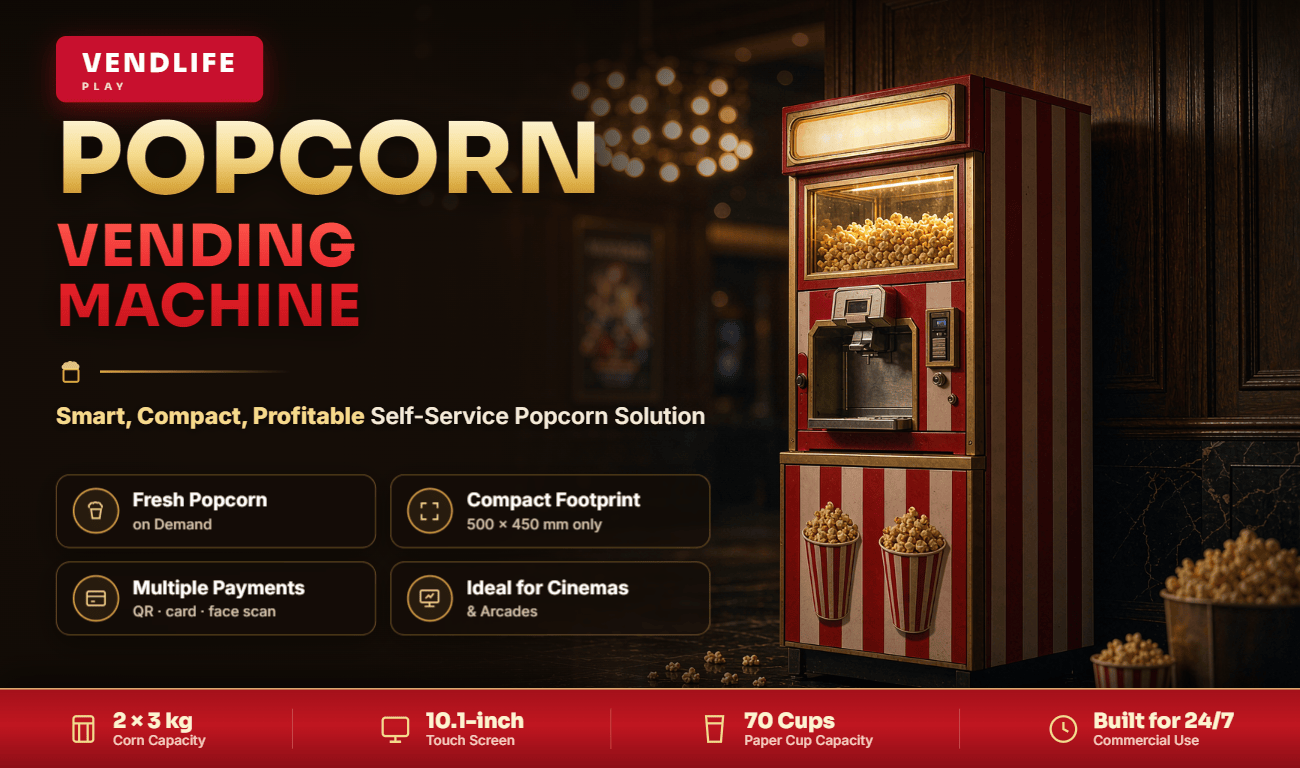
Specify thisRated draw (≈250 W on hot-air units), plug type, voltage version, floor area (≈0.5 m²)
Cabinet format
Concourse width and lease terms vary per venue
Specify thisSingle or double cabinet, wheel or plinth mounting
Ingredient handling
Stale oil and damp seasoning kill repeat sales
Specify thisTemperature-controlled holding, hopper volumes, clean-down routine
Outdoor readiness
Amphitheatres and festival fields are not lobbies
Specify thisDust and rain ingress rating, cabinet insulation for heat and cold
Sizing for a 20,000-capacity room
A 20,000-seat arena generates roughly the traffic of a mid-size shopping centre — inside a three-hour window. In practice, operators on sold-out nights run two linked units: one holds the queue while the second keeps popping, which also gives redundancy if a hopper runs dry at the interval. Two linked cabinets cost far less than the sales you lose to one long queue.
Fixed venue or touring deployment?
Fixed venue placement
Permanent power spur, cabled Ethernet, integration with the venue’s cashless policy and a locking plinth. Prioritise telemetry and peak throughput.
Touring & festival deployment
Mobile cabinet, 4G telemetry only, weatherproof cover and a spares kit that fits in the truck. Prioritise ruggedness and fast restock — and accept slightly lower peak throughput for a build that survives a 1 a.m. load-out.
Our fuller breakdown of event-night placements — stadiums, fan zones, cinemas and transit hubs — sits in the stadium and big-game venue playbook. The rest of this guide stays on the touring side.
The unit economics of a concert fleet
Operators do not buy machines, they buy payback periods. The model below is a framework for that conversation, not a quotation — re-run it with your own capture rate, price and lease terms.
| Tickets per show | 8,000 | 19,104 (Pollstar 2025 Top 100 average) | 56,272 (stadium average) |
|---|---|---|---|
| Snack capture rate | 3% | 5% | 8% |
| Average transaction | $6.00 | $7.00 | $8.00 |
| Gross per show | $1,440 | $6,687 | $36,014 |
| Ingredient + cup cost (≈15%) | $216 | $1,003 | $5,402 |
| Contribution per show | $1,224 | $5,684 | $30,612 |
Figures are illustrative. Column 1 = conservative, column 2 = mid, column 3 = aggressive.
Capture rate dominates
Doubling attendance moves weekly revenue less than lifting capture from 3% to 5% — and capture is a placement and queue-length problem, not a machine problem.
Labour is the structural saving
The contribution figures above carry no attendant cost. Across a 40-show touring calendar, that gap is the entire margin argument for unattended equipment.
Payback is a calendar question
A machine running five nights a week pays back far faster than an identical unit working one summer festival circuit — so size the fleet against the tour calendar, not the venue’s peak capacity.
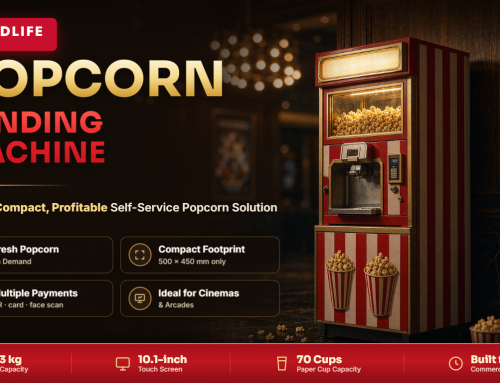
For the raw machine economics — capacity, popping cycle, daily throughput — start with our guide to the commercial popcorn vending machine before building the venue model on top of it.
Wholesale, distribution and OEM: how to buy at scale
This is the part of the market that moves in containers rather than units. Distributors, importers and multi-venue operators are not shopping for a machine — they are building a supply line, and five terms decide whether it works.
MOQ and tiered pricing
Ask for the price breaks before the sample unit, and ask what triggers each tier. A workable wholesale structure usually has three steps — sample, single container, repeat container — with spare-part bundles priced into the higher tiers rather than sold at list later. Vendlife accepts single-unit orders on standard models, while OEM and ODM projects are planned around a small minimum order quantity agreed at order stage. Confirm both against your own launch schedule.
Lead times that fit a tour calendar
Dates confirmed
Reserve capacity
Tour and festival dates announced — book production slots before the season window closes.
Artwork signed off
Release tooling
Private-label artwork, UI language and payment configuration approved, then print and tooling are released.
Build & QC
Production
Plan the build against the season, not against the week — including the inspection file for your broker.
Freight & customs
Land on date
Book ocean and inland legs against the venue handover date, never against the ship date.
Private-label and ODM options
Promoters, venue groups and rental fleets increasingly buy machines that carry the event’s identity. Configurable lines include full-surface branded wraps and header panels, boot-screen artwork, touchscreen UI language, the payment acquirer and the flavour line-up (sweet, caramel, cheese, butter — or your own blend). The machinery stays the same; only the cabinet and software surface change, which is what keeps OEM pricing predictable. Browse the wider programme on our customized vending machines page.
Certification and market access
For a distributor, paperwork is a sales tool. Confirm CE and FCC conformity for the destination markets and ISO 9001 production, and assemble the documentation set your customs broker will ask for. Against the backdrop of a vending market Persistence Market Research valued at US$73.2 billion in 2025 and still growing, distributors that can hand a procurement team a complete compliance file win tenders that machine-only sellers cannot enter.
Spare parts and after-sales: where distributor margin actually lives
The margin on a wholesale machine is thin and freight eats into it. The margin on the parts and consumables that machine consumes for the next five years is not. A sensible first order therefore includes a spares kit — heater element, control board, payment reader, door and dispensing hardware, plus a screen unit where the venue runs a 21.5-inch UI — and a remote-diagnostics arrangement so faults are triaged over 4G before anyone drives to site. Vendlife supplies these from its own factory in Foshan, Guangdong; buying direct from the vending machine manufacturer is what makes same-line spares available years after the order.
Distributors building a wider catalogue alongside popcorn can see how the same terms apply across categories in our note on commercial vending machines worth buying wholesale.
Outdoor festivals vs indoor arenas: engineering the placement
The machine does not change between an arena concourse and a festival field, but the failure modes do.
Indoor arena
Outdoor festival / amphitheatre
Voltage version
European, Middle Eastern and most Asian venues run 220–240 V; North American venues run 110–120 V. Confirm the version at order stage — a mismatched unit is a return, not an install.
Temperature-controlled holding
Summer fan zones and winter amphitheatres both stress ingredients. A temperature-controlled cabinet keeps kernels, oil and seasoning stable; without it, an afternoon load can degrade before doors open.
Weather reliability matters to the crowd too. atVenu’s 2025 review found festival food-and-drink spend dipping about 3%, driven mainly by what fans bought rather than whether they bought — a reminder that range and reliability, not mere availability, drive repeat spend.
A twelve-month plan around the concert calendar
The buying decision is seasonal even when the machine is not. This sequence keeps a fleet ahead of the touring calendar rather than behind it.
Intelligence
Map routing to your venues; estimate show counts per site
Commitment
Confirm MOQ, tiered pricing, voltage versions and spares kit
Build & ship
Private-label artwork, payment configuration, production, freight
Commissioning
Simulate an interval rush, verify telemetry, train restock staff
Season operation
Restock by consumption data, log faults, rotate spares
Review
Re-run the capture-rate model; re-order against next calendar
The quiet weeks matter as much as the loud ones. Between tours, the same cabinets keep earning in venues with daily footfall — the pattern mapped in our stadium and arena environments guide — and that baseline is what makes a concert-season surge profitable rather than merely busy.
Frequently asked questions
How many people can one popcorn vending machine serve at a concert?
Plan on one unit per 10,000–15,000 attendees for a conventional interval rush, and link two units side by side above that. The constraint is not total attendance but peak throughput during the 20–30 minute interval: one machine pops continuously while the second absorbs the queue. For sold-out stadium nights, double-cabinet configurations are the standard answer.
What is the MOQ for a wholesale popcorn vending machine order?
Standard models are available in single units, so a venue can test the concept before committing. Wholesale and OEM projects are planned around a small minimum order quantity and a production schedule agreed at order stage. Ask for the tier structure — sample, container, repeat container — and the spare-parts bundle attached to each.
Can the machine be branded for a tour, promoter or venue group?
Yes. Cabinet wraps and header panels, boot-screen artwork, touchscreen UI language, payment acquirer and flavour line-up are all configurable, which makes private-label popcorn machines practical for promoters and rental fleets that want the machine to match the show’s identity.
How long is the lead time, and can it align with a tour?
Standard machines ship quickly from stock. OEM and ODM projects follow a production lead time agreed up front, which is why the sequence in section 06 starts four to six months before the season opens rather than at the first show. Aligning delivery with your tour calendar, not your purchase-order date, is the point.
Which payment methods suit a concert venue?
Contactless cards, NFC mobile wallets and QR codes through an MDB/DEX payment stack. The fully cashless design matches stadium and arena payment policies, removes coin handling from a two-hour rush and gives the venue machine-readable sales data. Where a venue operates a closed-loop card or wristband system, specify the payment configuration at order stage.
Do you supply spare parts and technical support for distributors?
Yes — heater elements, control boards, payment readers, dispensing hardware and screen units, supplied from the same production line as the machines. Remote diagnostics over 4G or Wi-Fi handle most faults before a site visit, which is what keeps a distributor’s service cost per unit predictable.
Getting your fleet ready before the next tour announcement
Concert popcorn vending only fails for one reason: the machines arrive after the season has started. Operators who win the interval rush specified throughput, voltage and payment in the off-season; wholesalers who won the category locked MOQ, spares and private-label terms before routing went public. Tell us the venues you serve, the show counts you expect and your season’s first date — Vendlife builds on its own production line in Foshan, China and supplies operators, distributors and resellers factory-direct, with OEM and ODM configuration, workable MOQs and a spare-parts line behind every machine.